热压垫压塌原因:压缩永久变形详解
热压垫一个月就压塌,问题几乎从不是磨损,而是发泡体的压缩永久变形(compression set)。本文讲清 ASTM D 395 B 这个数字怎么读、四类真实成因、五分钟游标卡尺诊断表,以及采购单上必须写明的七项指标。
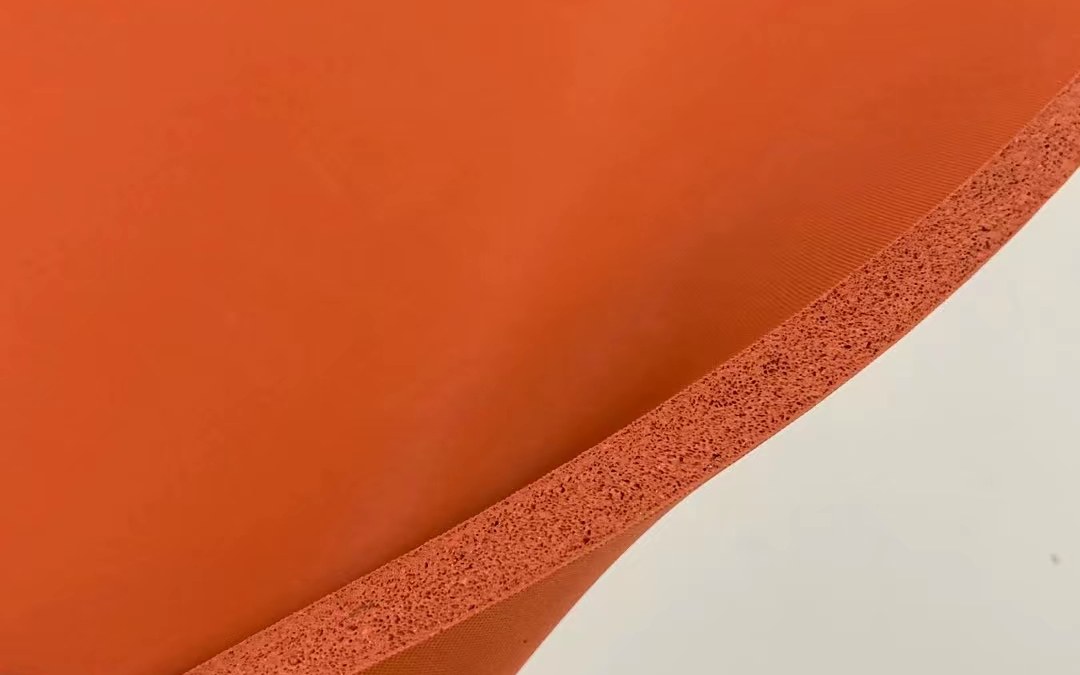
Almost every pad that "went flat in a month" is diagnosed as worn out. It is not. Silicone does not abrade under a platen and it does not melt at 200 °C. What changes is the cell structure: the foam stops coming back to its original thickness after each cycle. The press still closes to the same gap, but the pad no longer fills it, so pressure falls away at the centre and the pale halo returns around every motif. That is compression set — and because it is a measurable number, it is also something you can write into a purchase order instead of discovering after the fact.
Compression set in one paragraph
Compress a foam to a fixed fraction of its thickness, hold it at temperature for a set time, release it, then measure how far it springs back. ASTM D 395 method B does exactly that: 25 % deflection, 22 hours, 175 °C or 200 °C for silicone. The result is the percentage of original thickness that never came back. 10 % set means a 6 mm pad is now 5.4 mm; 30 % set means 4.2 mm, and the machine is effectively running a different pad from the one you specified.
Two properties of that number matter commercially. It is cumulative — a pad that sets 3 % in one hot cycle sets further in the next, and the curve only flattens once the cells have collapsed as far as they can go. And it is driven by time and temperature far more than by tonnage, which is why two shops at the same pressure get very different pad life at 150 °C and 190 °C.
What actually kills a pad in four weeks
| Cause | What you see | Why it happens |
|---|---|---|
| Closed cell foam used as a platen pad | Pad goes hard and thin, no spring left, edges lift | A closed cell has nowhere for the gas to go on compression, so it is forced out through the wall and never returns. Open cell breathes the air back in. |
| Density too low for the platen pressure | Deep grooves where the platen ribs sit, thinnest at the centre | The foam is crushed past its elastic range and the cell walls buckle. 0.25–0.40 g/cm³ is the working range for platen pads; below about 0.22 you are buying cushioning foam, not press foam. |
| Press left closed under pressure overnight | One clean flat spot exactly under the platen, recovers part way and stops | Set is time dependent. Eight hours held at 200 °C does more damage than eight hours of normal cycling, and it does it in one shift. |
| Pad creased or shifting on the platen | A groove or hinge line running across the pad | Foam held folded under load takes a permanent crease. Usually the adhesive backing has failed, or the pad was cut larger than the platen and the overhang folded up. |
Diagnosis in five minutes, with a caliper
Pull the pad, lay it flat at room temperature for an hour, then measure thickness at the centre, at four points 50 mm in from each corner, and at the middle of each edge. Compare against the thickness on the spec sheet, not against what it feels like.
| Caliper reading | What it means | What to do |
|---|---|---|
| 100–95 % everywhere | Healthy pad | Keep running, re-check quarterly |
| 95–90 % at centre only | Normal set for the hours on the clock | Usable. Re-check monthly and put a replacement on order |
| Below 90 % at centre | Set beyond recovery — pressure is already uneven | Replace. If it fails again inside a month, the density or thickness was wrong, not the batch |
| One local flat spot | Stored or left compressed | Change the end-of-shift routine before changing supplier |
| Edges 5–10 mm thinner than centre | Pad oversized, overhang crushed by the platen frame | Cut the pad to platen size — sheet size is not platen size |
If the reading is 94 % and the halo is already back, the pad is not the whole story: check that the garment stack is the same height across the platen, and that the thermostat is holding rather than cycling 15 °C low. A pad that recovers well can still print badly on an uneven load.
What to put on the purchase order
| Line item | Ask for | Why it matters |
|---|---|---|
| Cell structure | Open cell, stated explicitly | Closed cell will take a set — it is the wrong material for this job, whatever the datasheet calls it |
| Density | 0.25–0.40 g/cm³ | Below 0.22 the foam crushes instead of recovering |
| Compression set | ≤ 20 % to ASTM D 395 B, 22 h at 175 °C — with the test report | A number you can reject against. "Excellent resilience" cannot be rejected against |
| Hardness | 25–40 Shore 00 | Matches the platen pressure you actually run |
| Thickness tolerance | ±0.2 mm, ground | An uneven pad is an uneven print, before it ever compresses |
| Temperature | 200 °C continuous (220 °C for sublimation) | Headroom over the set point stops slow hardening |
| Backing and cut size | PSA or plain; cut to platen size +0/−2 mm | Stops the two failure modes — sliding, and crushed overhang |
Choose the right part, then buy it as a consumable
In a plant running two hundred loads a day a platen pad is a wear part, like a filter or a belt — it has a service life measured in cycles, not years. The job is to make that life predictable. For flat-bed transfer and sublimation work the right part is a plain open cell sheet, 3 to 12 mm depending on what you press: open cell silicone foam sheet, cut to your platen. Thickness selection is covered separately in 3 mm, 6 mm or 10 mm.
For dry cleaning and laundry presses, where steam has to pass through the pad and the vacuum has to pull it back out, a perforated pad recovers faster than a plain one because air moves in and out through the hole array as well as through the cell walls: moulded perforated silicone foam pad. The same compression-set logic decides pad life on an ironing table, where the load is continuous rather than cyclical — see the specs that decide pad life.
One word of warning on material choice: if a supplier offers you a firm, dense, skin-surfaced sponge because it "feels more durable", check the structure first. That is a closed cell sheet — excellent as a gasket, wrong as a platen pad. The comparison is in open cell vs closed cell silicone foam.
Quick answers
How long should a heat press pad last? A correctly specified open cell silicone pad runs thousands of cycles — typically six to eighteen months at one to two hundred cycles a day, depending on temperature and how long the press sits closed. A pad that fails inside a month was the wrong specification, not a defective batch.
Can a flat pad be recovered? Partly, and only once. Leaving it uncompressed at room temperature for a day returns a few percent of thickness; heat does not help and neither does flipping it. Below 90 % of original thickness the print quality is already affected, so replacement is the cheaper route.
Does a thicker pad last longer? Not by itself. Thickness buys travel to absorb zips and seams; density and cell structure decide whether the foam comes back. A 12 mm low-density pad can set faster than a 6 mm one at the correct density, because the thicker section sees more compression at the same gap.
把图纸或样品寄给我们,48 小时内回复选型与报价。
获取报价