Silicone Vacuum Bags for Composites: Drape, Cure Temperature and Resin Compatibility
A silicone vacuum bag for composites has to follow a three-dimensional tool without bridging, survive a 120-180 C cure, and stay chemically clean against uncured resin. This guide covers how thickness, hardness, seam construction and port placement are chosen for real layups, and where a reusable bag stops paying off.
Bagging a composite part is not the same problem as bagging a solar module or a glass panel. The tool is three-dimensional, with radii, returns and sometimes undercuts; the laminate is tacky, so anything touching it leaves a mark; and the bag must hold vacuum through a cure that can run for hours at 120 °C to 180 °C. A silicone vacuum bag for composites is chosen against those conditions, not against a single temperature rating.
Why composites shops move away from nylon film
Consumable nylon or PVA film is cheap per square metre. The economics change when a tool runs repeatedly: every layup consumes film and sealant tape plus 20 to 40 minutes of skilled labour to bag, pleat and leak-check. On a part that runs weekly, that labour and the scrap from bagging defects usually cost more than a reusable bag would.
A silicone bag changes the workflow: fitted once to the tool or frame, sealed with a vulcanised edge or a clamp, then reused for hundreds of cycles. The trade-off is that it is a fixed geometry, designed around the tool and specified for the cure cycle and resin, or it fails early in a way that is harder to diagnose than a punctured film.
The four loads a composite bag has to carry
1. Drape over three-dimensional tooling
A membrane on a deep mould is stretched hardest at the sharpest radius and barely at all on a flat face, so the material must be selected for the corner, not the average. Platinum-cured silicone with high elongation and fast elastic recovery draws into recesses instead of spanning them, and springs back without taking a permanent set that would bridge on the next cycle.
2. Cure temperature and ramp rate
Most prepreg systems cure between 120 °C and 180 °C, often with a ramp faster than the bag would like. Continuous service rating matters more than peak tolerance. A reinforced bag rated to 180 °C for continuous lamination work carries enough margin for a standard cure, but one run repeatedly at its limit will harden and lose elongation long before it tears. Ask for the continuous rating, not the short-term peak.
3. Resin, styrene and volatiles
Polyester and vinyl ester systems release styrene; epoxy amines and anhydrides are aggressive in their own way. Silicone is inert against most of these, which is one reason it beats natural rubber here. What it does not tolerate is surface contamination: cured resin, release-agent build-up and trapped flash all cut sealing ability and eventually cause pinholes. A bag wiped and inspected between cycles lasts far longer than one folded away wet.
4. Vacuum integrity under clamping
A bag leaks at its edges and ports, almost never in the middle of a panel. Clamped edges see the highest stress concentration, and a cut edge is where a tear starts. Vulcanised edge beads and seamless bonded joints move the failure point away from the clamp — the same reason a membrane supplied pre-trimmed to its frame outperforms a raw sheet clamped at the border.
Matching bag thickness to the tool
Thickness decides both drape and life, and the two pull in opposite directions. A thin bag conforms beautifully but splits at radii; a thick bag resists tearing but bridges deep recesses. Practical starting points:
| Tool and process | Starting thickness | Reasoning |
|---|---|---|
| Flat or single-curvature tools, cure at or below 120 °C | 1.5 mm | Maximum drape, easiest pleating; tear loads low |
| Moderate 3D tools, 120–150 °C cure | 2.0 mm | Usual balance of conformability and radius strength |
| Deep draws, tight radii, high cycle counts | 2.5–3.0 mm | Tear resistance dominates; drape handled by pleat design |
| Large panels on a frame or platen | 1.5–2.0 mm | Even pressure across the field without extra bridging risk |
These are starting points, not a specification. The number that settles it is the deepest draw divided by the tightest radius. Where that ratio is high, thickness goes up and hardness comes down, because a softer compound draws into the recess while a harder one spans it. The 800 mm door press shows the trade clearly: moving from a 1 mm sheet to 2 mm at 60 Shore A — thicker but softer than the stiff sheet already rejected — cut replacement frequency by roughly 70 %. See the 800 mm mould press case study.
Bridging, pleating and the corner rule
Bridging is not a material defect; it is a geometry mistake. It appears wherever the bag must travel further than the material can stretch, and shows up as a void, a resin-rich patch, or a radius that never consolidates. Three habits prevent most of it:
- Pleat at the radius, not on the flat. Extra material belongs where the bag changes direction; pleats on flat faces print through the laminate.
- Give the bag a path, not slack. A pleat taped flat becomes a crease under vacuum; one allowed to fold on itself as the bag draws down distributes the extra length.
- Check the tightest corner first. If the bag bridges anywhere, it bridges at the smallest radius. Pull vacuum slowly on a dry run and watch that corner before committing a layup.
Ports, manifolds and where leaks start
Composite tools often need more than one vacuum line: one at the far end of a long part, one near a deep recess, sometimes a separate line under a caul plate. Every port is a joint and every joint is a candidate leak. Place ports where the bag is under least tension, usually on a flat return rather than a radius, and space them evenly along the longest dimension so the pressure front arrives everywhere at once. Port hardware should be moulded into the bag during manufacture, not bonded on afterwards — a bonded port is a glued interface in the hottest, most stressed part of the assembly. On the line side, a soft kink-resistant silicone tubing stays flexible at cure temperature instead of collapsing under vacuum as a cheap PVC line does at 150 °C.
When a membrane is the better answer
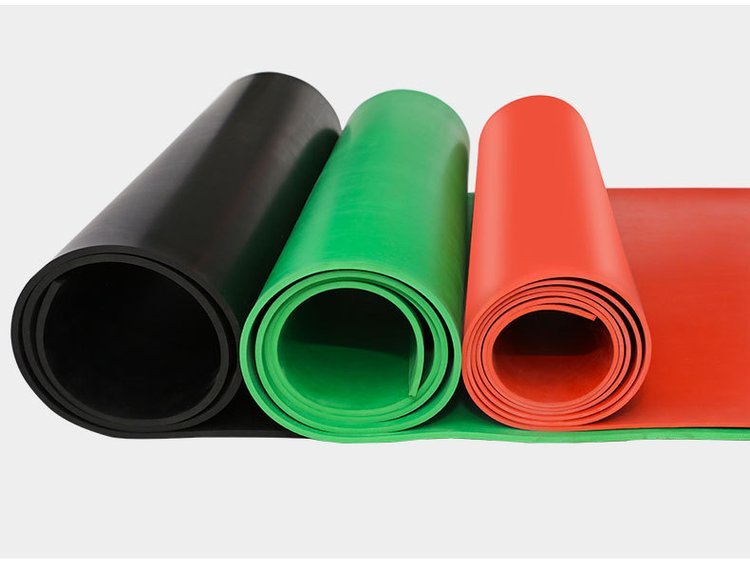
If the tool can be enclosed — a press platen, an oven with a frame, a vacuum table — a flat or frame-mounted diaphragm is simpler than a shaped bag and easier to inspect. A silicone membrane for vacuum presses is calendered from high-consistency rubber and vulcanised into a seamless sheet, offered in 1–5 mm at 60±5 Shore A with 800 % elongation and continuous service to 230 °C, up to 3800 mm wide, from 5 m². Use a bag when the part must be bagged on the tool itself, a membrane when the press supplies the frame; the vacuum press application guide walks through that decision for woodworking, thermoforming and composite presses.
What to send with a bag inquiry
Bag geometry is made to order, so the quote is only as good as the information behind it. Send the tool drawing with the deepest draw, the tightest radius, the cure cycle with ramp and dwell, the resin family, and expected cycles per month. Where a shaped bag is new to a process, a trial bag in 2 mm is the fastest way to learn whether pleating or thickness is the limiting factor. Standard reinforced high-temperature bags run 1.5–3 mm, seamless or fully vulcanised, rated to 180 °C and 500+ cycles, from one set, with 10–20 day lead times; full specification is on the silicone vacuum bag for solar laminators page.
Frequently asked questions
Can a silicone vacuum bag be used in an autoclave?
Yes, if the compound is rated for the cure temperature and the bag is supported so pressure cannot push it into an undercut. Autoclave pressure adds load that a bag in an oven or press never sees, so thickness and port reinforcement should be specified for that higher differential.
How many cycles should I expect from a composite bag?
Tool and handling decide it far more than material. Bags on tight radii, hot cures and rough handling fail first. A reinforced bag rated for 500+ cycles is a fair baseline for a well-designed tool, but the real number is set by the sharpest corner on the part.
Does resin stick to silicone bags?
Less than to most bagging materials, but not never. Cured epoxy releases cleanly from a sound silicone surface; partially cured resin and accumulated release agent will bond. Wipe the bag after each cycle and inspect the radius areas, where residue collects first.
Talk to us about your tool
SHINEKIM Silicone has manufactured silicone membranes, vacuum bags and moulded parts in Shanghai since 2017, exporting to 60+ countries under ISO 9001. Moving a composite part from consumable film to a reusable bag? Send the tool drawing, the cure cycle and a photo of the corner that worries you. Jonathan will reply with a thickness and hardness recommendation, and we will ship a free sample for a dry cycle before you commit to a set. WhatsApp +86 131 4075 9279 or email shinekimrubber@163.com.
Send a drawing or sample — we reply with a recommendation and quotation within 48 hours.
Request a Quote