Silicone Roller Covering: Hardness, Crown and Surface Finish
A roller that releases cleanly at 120 m/min is a specification, not a lucky purchase. What to state when ordering silicone covered rollers.
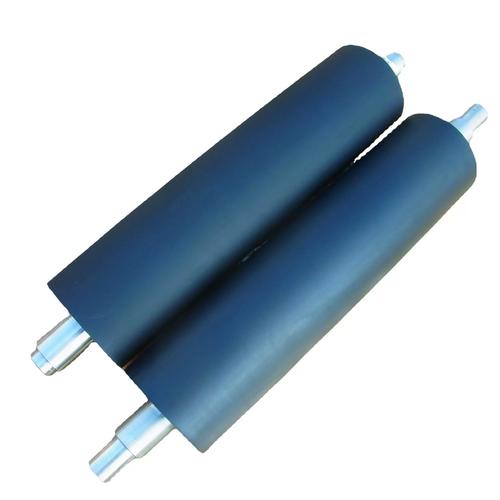
Silicone covered rollers are used wherever hot material must pass through a nip without sticking: lamination, hot stamping, film converting, textile finishing. Three parameters decide whether the roller works.
Hardness
Softer covers (30–50 Shore A) give a wider nip and are forgiving of thickness variation — good for laminating films and foils. Harder covers (70–90 Shore A) give precise pressure and longer life — good for metering and coating.
Crown
Every roller deflects under nip load. A crowned cover compensates: the diameter at the centre is slightly larger so pressure stays even across the width. If your laminator produces edge-only bonding, the crown is wrong or missing. State the nip load and the face width, and let the supplier calculate the crown.
Surface finish
- Mirror ground — best release, used for optically clear film
- Matte — slight texture for grip and air bleed
- Grooved — channels for trapped air in high-speed nips
Tolerances worth insisting on
| Property | Typical requirement |
|---|---|
| Concentricity (TIR) | ≤ 0.02 mm |
| Diameter tolerance | ± 0.05 mm |
| Surface roughness | Ra 0.4 – 0.8 µm (mirror) |
| Bond to core | No slip at rated torque |
Refurbishment instead of replacement
Worn silicone covers can usually be stripped and re-covered onto the original core for 40–60% of the cost of a new roller, with the same concentricity. It also avoids re-machining journals and re-balancing.
SHINEKIM covers rollers up to 3,000 mm face length in 30–90 Shore A, ground to your finish and concentricity requirement, and offers a rebuild service for worn rollers.
Send a drawing or sample — we reply with a recommendation and quotation within 48 hours.
Request a Quote